
The Scope Creep Epidemic: Why Projects Fail Before They Start
Projects don't fail at execution, they fail at articulation. The moment you can't describe success in one sentence, you've already lost.


Table of Contents
Share this article
Table of Contents
Share this article
The $600 Million Disaster
In October 2013, Healthcare.gov launched. The price tag: hundreds of millions of dollars. The contractors: dozens of different companies. The result: a system so broken that only 6 people successfully enrolled on day one.
The post-mortems blamed technical failures. Server overloads. Integration nightmares. But the Government Accountability Office report told a different story: ineffective planning and oversight, weak contract management, and governance that didn't hold milestones tightly enough.
Fifty-five contractors doesn't automatically mean failure. But zero unified definition of success makes failure almost inevitable.
I've spent years managing software delivery, and I've watched this pattern repeat at every scale. Not with $600 million budgets, but with the same root cause. Projects don't fail because developers can't code. They fail because nobody wrote down what "done" actually means.
This is the scope creep epidemic. And it's not what you think.
What Scope Creep Actually Is
Most people think scope creep means features expanding mid-project. That's the symptom, not the disease.
The disease is the fuzzy brief: a project directive so vague that you can't prove success or failure.
You must have seen or heard these:
- "Make it more modern"
- "Improve user engagement"
- "Build an MVP"
- "Create a better experience"
Each sounds like direction. Believe me, none of them are.
"Modern" compared to what? "Engagement" measured how? "MVP" of which features? "Better" according to whom?
Here's the test: Can you write an acceptance test for it?
If you can't write a statement that says "The project succeeds if X, and fails if not-X," you don't have a brief. You have a hope.
A brief that says "Users can complete checkout in under 3 clicks" is clearer than a 50-page document full of "intuitive" and "seamless" and "world-class." Clarity is not about detail. The real question is, can it be measured.
So if fuzzy briefs are the disease, how common is the infection?
The Numbers Behind the Epidemic
PMI's Pulse of the Profession 2023 found that organizations prioritizing communication and alignment skills reported 28% scope creep. Those that don't? 40%.
This gap matters as it shows that scope creep isn't inevitable. It's correlated with how well teams define and govern work before building starts.
But here's the worse news.
Wellingtone's State of Project Management 2021 found that only 52% of projects mostly or always create a scoping document during planning. Only 58% apply a defined methodology.
That means nearly half of all projects start without a written definition of what they're building. They're not just set up for scope creep, they're set up for scope chaos.
For startups, this shows up as the "pivot" that wasn't a pivot, it was never defined in the first place.
For agencies, it's the familiar excuse: "The client changed their mind." But, changed from what? If success criteria weren't documented, then the client didn't change anything. You just discovered you were never aligned.
The billion dollar question is, why does this keep happening?
The Four Ways Projects Die Before They Start
In my years managing delivery, I've watched projects fail in four predictable patterns. Each one kills the project before execution begins.
1. The Vibes-Only Vision
No written requirements. Just enthusiasm and a slide deck. The founder is excited. The team is excited. But when you ask what version 1.0 actually contains, you get hand-waves and "you'll know it when you see it."
You won't. And neither will they.
2. The Inherited Assumption
"Everyone knows what we mean." There's assumed shared context that doesn't actually exist. The designer thinks "clean" means white space. The developer thinks it means minimal code. The client thinks it means "like Apple."
Three people. Three definitions. Zero alignment.
3. The Scope-by-Committee
Too many stakeholders, no single decider. Every meeting adds requirements. Nobody removes them. The backlog becomes a landfill of "nice-to-haves" that everyone agreed to because nobody had authority to say no.
4. The Moving Goalpost
Success criteria defined retroactively. The project delivers what was asked. Stakeholder reviews it. "Actually, when I said X, I meant Y." The target moved after the arrow was shot.
This isn't client indecision. It's your failure to document what they decided.
Denver International Airport's baggage system remains a textbook example of where these patterns lead: complexity escalated, expectations shifted, governance failed, and a $186 million system became a public disaster.
But even without that scale, fuzzy briefs extract a cost most teams never calculate.
The Costs Nobody Budgets For
Every project budget accounts for development hours. Nobody budgets for the cost of ambiguity.
The rework cost: Developer burnout isn't caused by hard problems. It's caused by building something, learning it was wrong, and rebuilding it—sometimes multiple times. That's not a skills issue. That's a definition issue.
The trust cost: When expectations were never aligned, every delivery feels like a miss. Clients blame agencies. Agencies blame clients. Teams blame leadership. The brief never gets blamed because nobody thinks a brief can be wrong.
The opportunity cost: Every hour spent rebuilding a fuzzy feature is an hour not spent building the next one. Scope creep doesn't just cost what you built, it costs everything you didn't.
The compounding cost: You'll often hear that fixing a requirements defect after launch costs "100x more" than fixing it early. The exact multiplier varies by context, but the pattern is consistent: late changes are far more expensive than early clarity because you pay for rebuilds, retesting, recoordination, and reputational damage.
This brings up the obvious question: if the cost is this high, why don't more teams invest in clarity upfront?
Part of the answer is cultural. We treat scope definition as administrative work, the boring paperwork before the "real" work starts. But definition is the work. It's the hardest thinking in the project.
Working in insurance delivery taught me this viscerally. I had inherited a project that was "80% complete." Note that it had been 80% complete for three months. Every week, the team delivered something. Every week, the client said it wasn't quite right. "This isn't what we envisioned." But when I asked to see the vision document, I got a SharePoint link of scattered conversations and a slide deck from six months prior that nobody remembered agreeing to.
The project wasn't 80% complete. It was 0% complete, because nobody had defined what 100% meant. In insurance, you can't claim something wasn't agreed upon. It has to be written. Signed. Archived. The rigor feels excessive until the moment it saves you.
Software teams often resist that rigor. And then they wonder why they're rebuilding features for the third time.
So what does proper scope definition actually look like?
The Clarity Framework
Before any project begins, four questions must have documented answers.
Question 1: What does "done" look like?
Not aspirations. Acceptance criteria.
"The user can create an account, log in, and view their dashboard" is an answer. "An intuitive onboarding experience" is not.
Write it down. Make it falsifiable. If someone can't read your answer and objectively verify whether the project achieved it, you haven't answered the question.
Question 2: What are we explicitly NOT building?
Scope boundaries matter as much as scope definitions.
Every project has adjacent features that "would be nice." Document them as out-of-scope. In writing. With stakeholder sign-off.
When scope creep arrives, and it will, you'll have a reference point: "We agreed on Day 1 that X was out of scope. Adding it now requires a change request."
Question 3: Who decides if it's done?
Not who has opinions. Who has authority.
One person. Named. Documented. This person reviews deliverables. This person signs off. Committee consensus is how scope creep wins.
Question 4: What happens if requirements change?
They will change. Barry Boehm's work on risk-driven development established that assuming requirements won't change is itself a project risk.
The question isn't "will they change" but "what's the protocol when they do?" Who approves changes? How does it affect timeline and budget? Is there a cut-off point?
A 30-minute meeting that covers these four questions can save 30 hours of rework. It's not bureaucracy. It's protection.
To make this practical, here are two templates you can use immediately.
Why This Matters More in 2026
AI changes the equation, but not how most people expect.
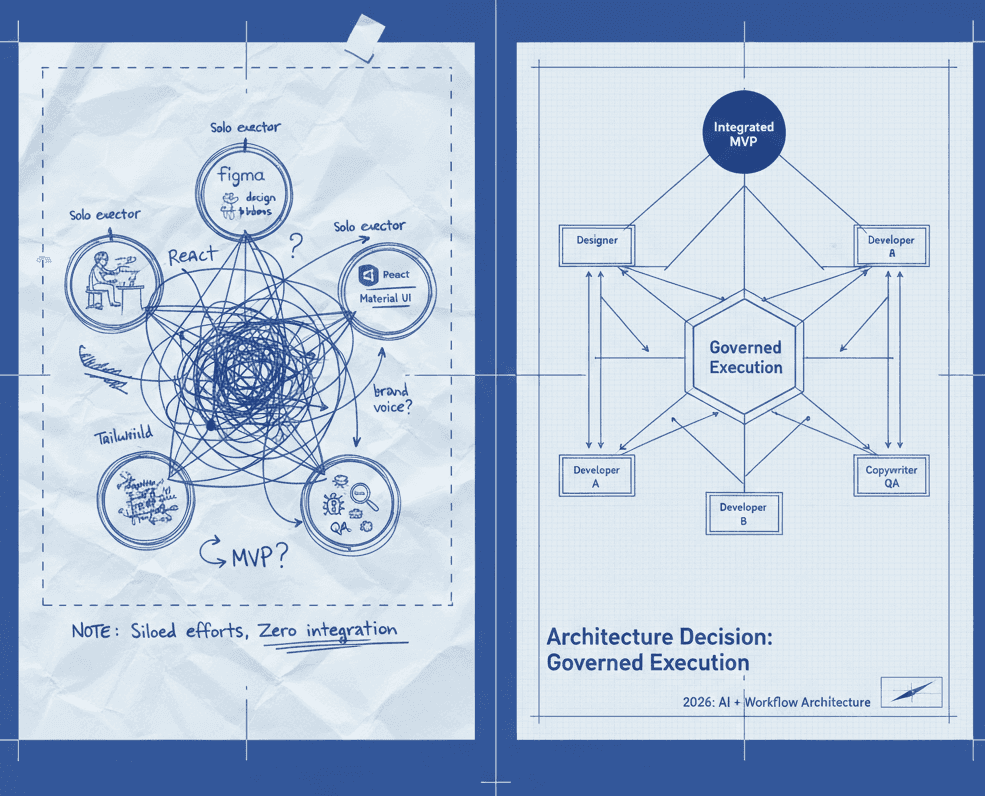
AI doesn't solve the fuzzy brief problem. It accelerates it. When code generation is faster, building the wrong thing happens faster too. The cost of ambiguity compounds.
Basecamp's Shape Up methodology offers one model for handling this: define an "appetite" (a time budget) before defining features. This forces teams to decide what fits within constraints, rather than letting scope expand to fill available enthusiasm.
The companies that will win in 2026 won't be the ones with the fastest execution. They'll be the ones who treat scope definition as a competitive advantage. They'll build less but ship more, because everything they build was defined before it started.
Undiluted Truth
Scope creep is a symptom. The disease is the fuzzy brief—project directives that can't be proven true or false.
Late-stage changes are consistently more expensive than early clarity. The exact multiplier varies, but the pattern doesn't.
Four questions prevent most scope disasters: What does done look like? What are we not building? Who decides? What happens when requirements change?
If you're experiencing scope creep, missed deadlines, or teams that "don't understand the vision", you're not alone. These patterns are everywhere. And they're solvable.
The fix isn't better software. It's not more standups. It's not different developers.
It's a 30-minute conversation where someone writes down what "done" actually means.
Related Articles
Continue exploring workforce technology insights




Never Miss an Insight
Subscribe to our newsletter for the latest workforce technology insights, research findings, and practical guides delivered to your inbox.